How to Convert Recipe Measurements Between Imperial and Metric
Cooking from a recipe that uses unfamiliar measurements? Use this quick imperial-to-metric conversion guide for cups, tablespoons, ounces, pounds, temperatures, and more.
The Spiceful Team
You find a recipe you want to make tonight. Then you get to the ingredient list: 250 grams of flour, 180°C, and 500 milliliters of stock.
If your kitchen uses cups, fluid ounces, and Fahrenheit, you suddenly have a little math to do before you can start cooking.
The reverse happens too. A recipe might call for 2 cups of flour and a 400°F oven when grams and Celsius are what you use every day.
The good news: most everyday recipe measurements are easy to convert once you know the basics. Keep this guide nearby for the next time a recipe speaks a different measurement language than your kitchen.
Imperial vs. metric measurements
Recipes generally use one of two measurement systems.
Imperial and U.S. customary measurements commonly use cups, teaspoons, tablespoons, fluid ounces, ounces, and pounds.
Metric measurements use milliliters, liters, grams, and kilograms.
Temperature is another common difference. Many U.S. recipes list oven temperatures in Fahrenheit, while recipes from much of the rest of the world use Celsius.
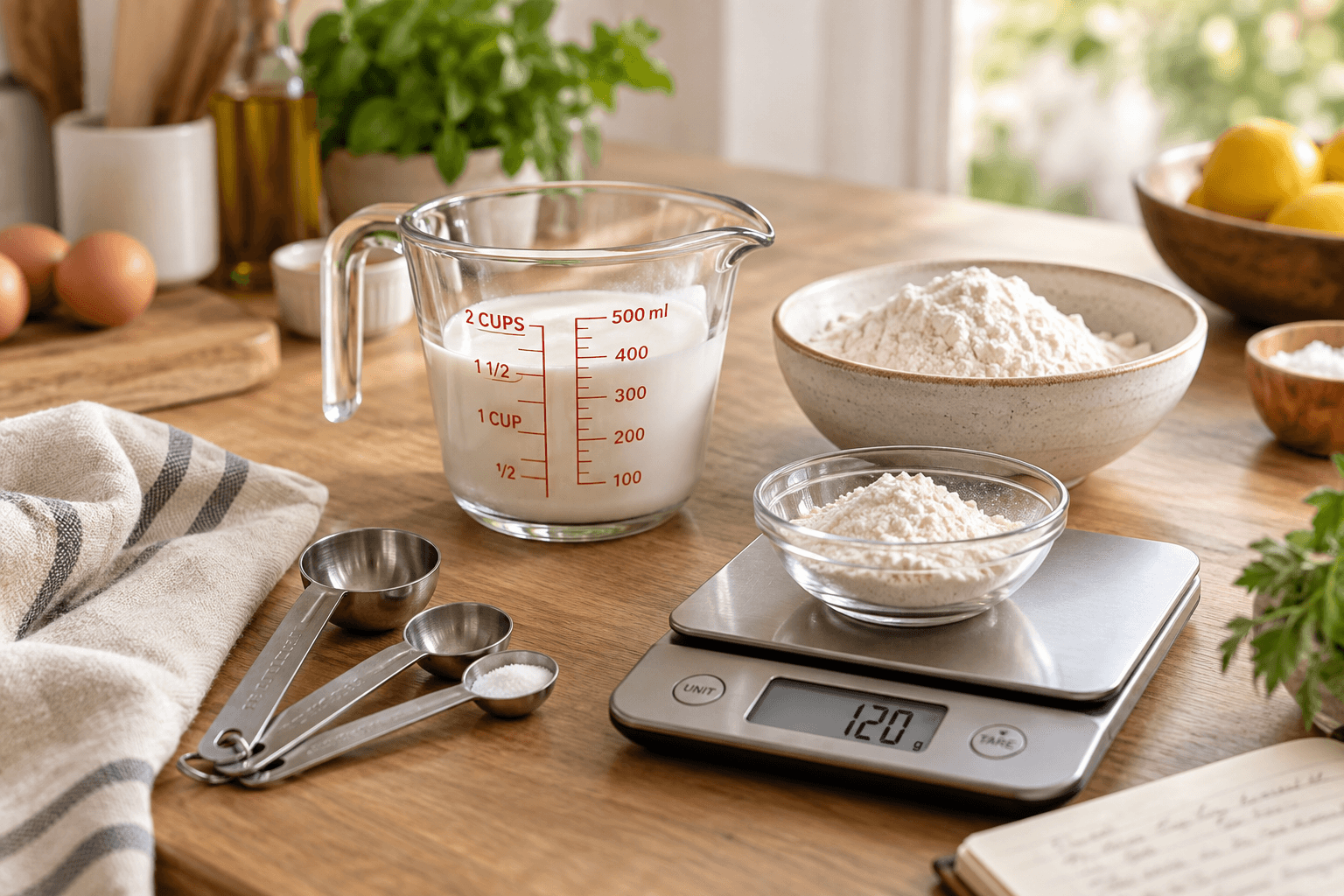
The important thing to remember is that volume and weight are different. A cup measures volume. A gram measures weight. That distinction matters when you start converting ingredients.
Quick volume conversion chart
For everyday cooking, these rounded conversions are usually the most useful:
| Imperial / U.S. | Metric |
|---|---|
| 1 teaspoon | 5 mL |
| 1 tablespoon | 15 mL |
| 1/4 cup | 60 mL |
| 1/3 cup | 80 mL |
| 1/2 cup | 120 mL |
| 2/3 cup | 160 mL |
| 3/4 cup | 180 mL |
| 1 cup | 240 mL |
| 2 cups | 480 mL |
| 4 cups | 960 mL |
*The chart below uses common U.S. cooking measurements.
For most home cooking, rounding 4 cups to about 1 liter is perfectly practical.
A note about cups
Not every "cup" is exactly the same.
A U.S. customary cup is about 237 mL and is commonly rounded to 240 mL for cooking. A metric cup is 250 mL. Some recipes may use different standards depending on where they were published.
For a soup or sauce, that small difference is unlikely to matter much. For baking, it can.
Quick weight conversion chart
Weight conversions are more straightforward because you're converting one unit of weight to another.
| Ounces / pounds | Grams / kilograms |
|---|---|
| 1 oz | 28 g |
| 2 oz | 57 g |
| 4 oz | 113 g |
| 8 oz | 227 g |
| 12 oz | 340 g |
| 16 oz / 1 lb | 454 g |
| 2 lb | 907 g |
| 2.2 lb | 1 kg |
For quick kitchen math, you can usually remember:
1 ounce ≈ 28 grams
1 pound ≈ 454 grams
1 kilogram ≈ 2.2 pounds
Can you convert cups directly to grams?
Not with one universal formula.
This is where recipe conversion gets a little more interesting.
A cup measures volume, while grams measure weight. One cup of flour does not weigh the same as one cup of sugar, butter, rice, or honey.
For example, imagine filling the same measuring cup with flour and then with honey. The volume is identical. The weight definitely isn't.
So if a recipe gives an ingredient in cups and you want grams, use a conversion for that specific ingredient rather than a generic cups-to-grams calculation.
This matters most in baking, where small differences in flour, sugar, or butter can change the final result.
Fahrenheit to Celsius for cooking
Oven temperatures are another common conversion when cooking recipes from another country.
Here are the temperatures you'll see most often:
| Fahrenheit | Celsius |
|---|---|
| 250°F | 120°C |
| 275°F | 135°C |
| 300°F | 150°C |
| 325°F | 165°C |
| 350°F | 175°C |
| 375°F | 190°C |
| 400°F | 200°C |
| 425°F | 220°C |
| 450°F | 230°C |
| 475°F | 245°C |
| 500°F | 260°C |
If you need to calculate a temperature that isn't on the chart, use:
Celsius = (Fahrenheit - 32) × 5/9
To go the other direction:
Fahrenheit = (Celsius × 9/5) + 32
Thankfully, you probably don't need to do that calculation every time. Most recipes land on a fairly small set of standard oven temperatures.
When exact conversions matter
Not every recipe needs laboratory-level precision.
If you're making soup and the recipe calls for 2 cups of stock, using roughly 480 to 500 mL isn't going to ruin dinner. The same goes for many sauces, stews, marinades, and savory dishes.
Baking is different.
A little too much flour or too little liquid can change the texture of bread, cookies, or cake. When a baking recipe provides ingredient weights in grams, using a kitchen scale is usually the easiest way to follow it accurately.
A simple rule:
Cooking gives you room to round. Baking rewards precision.
A few conversion mistakes worth avoiding
The numbers aren't usually the tricky part. It's knowing what you're actually converting.
Don't treat fluid ounces and ounces as the same thing
Fluid ounces measure volume. Ounces measure weight.
"8 fl oz milk" and "8 oz cheese" are two different types of measurement, even though they both contain the word ounce.
Don't use one cups-to-grams conversion for every ingredient
A cup of flour and a cup of brown sugar occupy the same volume but have different weights.
Look up the conversion for the ingredient itself.
Check where the recipe comes from
A cup, tablespoon, or oven temperature may be defined slightly differently depending on the recipe's country of origin.
If precision matters, especially when baking, follow the units supplied by the recipe whenever possible.
Don't overthink recipes that don't require it
Your pasta sauce probably doesn't care whether you used 237 or 240 mL of stock.
Use precision where it changes the result. Round sensibly everywhere else.
The conversions worth remembering
You don't need to memorize an entire conversion chart.
A handful of numbers will get you through most recipes:
- 1 teaspoon ≈ 5 mL
- 1 tablespoon ≈ 15 mL
- 1 cup ≈ 240 mL
- 1 ounce ≈ 28 g
- 1 pound ≈ 454 g
- 1 kilogram ≈ 2.2 lb
- 350°F ≈ 175°C
- 400°F ≈ 200°C
That's enough to make most unfamiliar recipes feel a lot more familiar.
Less kitchen math, more cooking
Measurement differences become especially annoying when you're planning several recipes at once.
One recipe calls for an onion. Another lists 1/2 cup chopped onion. A third calls for 200g minced onion. Now you're not only deciding what to cook. You're figuring out how all those measurements translate into what you actually need to buy.
That's exactly the kind of grocery math Spiceful is built to handle.
Spiceful can consolidate ingredients across the recipes in your meal plan, including ingredients written in different measurement formats, into one organized grocery list. So instead of three separate onion entries, you can see what you actually need to shop for.
Save the recipes. Plan the week. Let Spiceful handle the grocery math.
Ready to tame the chaos? Build your recipe book.
- Save recipes from anywhere
- Turn ingredients into one tidy list
Start free. No credit card needed. Upgrade anytime.