How to Fix a Broken Sauce Without Making It Worse
A diagnosis-first guide to split hollandaise, separated vinaigrettes, curdled cream sauces, and greasy cheese sauce, with a repair method suited to each problem.
The Spiceful Team
A broken sauce is rarely improved by panic-whisking it over high heat while whispering, “come on, man.”
First move: take it off the heat.
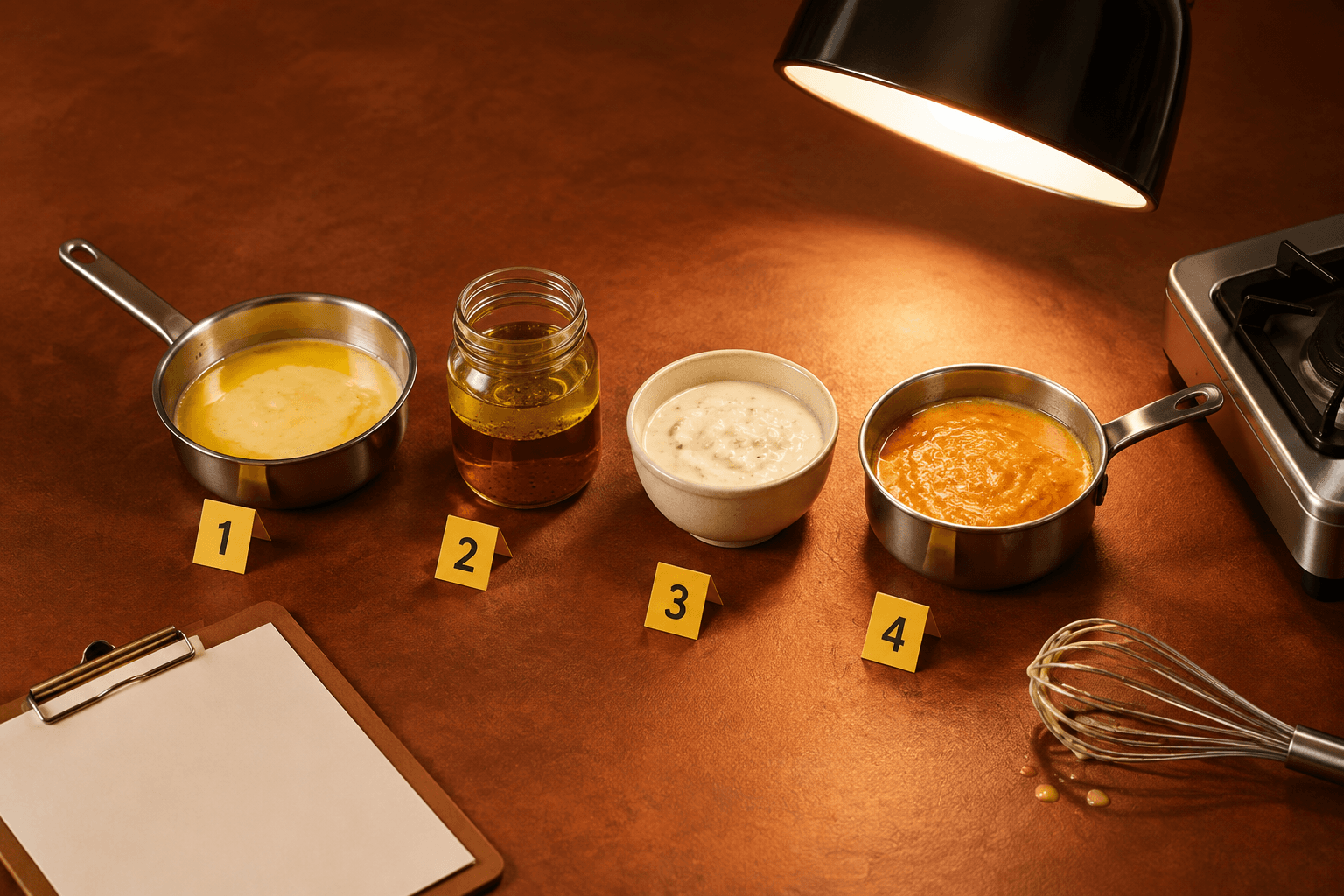
Then figure out what happened. “Split” is an umbrella complaint, like “my computer is being weird.” A hollandaise with an oily puddle, a vinaigrette that settled while you set the table, and a cheese sauce full of tiny grains may look vaguely related, but they need different treatment.
Look before you grab the whisk

Use the sauce’s appearance, ingredients, and recent history to choose a repair path.
| What you see | Likely issue | What to do first |
|---|---|---|
| An oily layer or ring around a thin, mostly smooth sauce | A broken fat-in-water emulsion | Remove it from heat and rebuild the emulsion gradually |
| A vinaigrette that separated after sitting | A temporary emulsion doing temporary-emulsion things | Shake or whisk it again |
| Tiny curds, grains, or a cottage-cheese-like texture in a cream or milk sauce | Dairy proteins have coagulated | Stop heating and handle it gently. It may improve, but perfect smoothness may not return |
| Oily, grainy cheese sauce | Separated cheese fat, possibly with disrupted proteins | Remove it from heat. Try a suitable liquid only if it fits the sauce |
| A sauce that is thick and concentrated but not oily or grainy | It may be over-reduced | Thin it with a liquid that suits the recipe |
Some sauces manage to fail in more than one way at once. Diagnosis will not require a forensic lab, but it can stop you from adding lemon juice to a curdled cream sauce because a blog claimed water fixes everything. Water is lovely. It is not a sauce exorcist.
Why sauces split
Many sauces are emulsions: tiny droplets of fat dispersed through a water-based liquid. Butter and egg yolk in hollandaise, oil and vinegar in dressing, and some pan sauces depend on those droplets staying small and spread out.
Egg yolk and mustard contain compounds that help stabilize emulsions. The structure can still fail when fat goes in too quickly, the sauce gets too hot, mixing is insufficient, or the temperature is wrong for that particular sauce. The fat droplets join together, and your glossy sauce develops an oil slick.
Dairy sauces can fail through a different mechanism. Milk proteins may coagulate after too much heat or a strong acidic condition, forming visible curds or grains. A greasy cheese sauce may also have separated fat and disrupted proteins. It can resemble a broken emulsion, but treating it exactly like hollandaise is how dinner becomes an elective in regret.
If hollandaise, béarnaise, or another egg-and-fat sauce broke
This is the classic broken-emulsion situation: the sauce looks thin, greasy, or separated, but it does not contain distinct dairy curds.
Take the pan off the heat. Do not keep trying to repair it while it is actively cooking.
A useful method, described by Serious Eats, is to make a fresh, small base in a clean bowl. Use a little water or another liquid that suits the sauce, then whisk in the broken sauce gradually. Start with a small addition. Once the new mixture looks cohesive, continue slowly. You are building a stable structure around the broken sauce instead of trying to bully the entire batch back together at once.
A few practical notes:
- Use a clean bowl instead of continuing in an overheated pan.
- Add the broken sauce in small additions at first.
- If the sauce was extremely hot, let it cool briefly before rebuilding. If it became cold and stiff, any warming should be very gentle and specific to that sauce.
- The right liquid depends on the recipe. Lemon juice can suit hollandaise, but it is not a universal sauce fix and is a poor random choice for dairy.
A fresh egg yolk is another classic rebuilding base for a suitable egg sauce. It can work, but it changes the formula, adds richness and volume, and requires appropriate egg handling. Follow the recipe’s safe-handling guidance. A sauce becoming smooth again tells you about its texture, not its safety.
If the repaired sauce is a little looser or less glossy than before, that can still be a perfectly serviceable dinner. Put it on the asparagus. Nobody at the table is conducting a blind texture audit.
If your vinaigrette separated, it may be normal
Oil-and-vinegar dressings are often temporary emulsions. They separate because oil and water have remembered they are not friends.
Whisk or shake the dressing before serving. That is maintenance, not emergency surgery.
If it separates almost immediately and you want it to stay together longer, use an emulsifier that fits the dressing, such as mustard, and add the oil gradually rather than dumping it in all at once. Many homemade vinaigrettes will still settle eventually. They have places to be.
A separated vinaigrette usually does not need a clean-bowl rebuild. It needs agitation and a realistic understanding of what kind of dressing you made.
If a cream, milk, or cheese sauce is grainy or curdled
Remove it from heat immediately. Continuing to boil is how a recoverable problem becomes sauce confetti.
Visible curds or graininess suggest that dairy proteins have coagulated. That structural change may not reverse completely. Sometimes gentle handling improves the sauce. Sometimes it has had a difficult evening and remains a little weird.
For a mildly split or overly thick dairy sauce, gradually whisking in a liquid that suits the original recipe may improve the texture. Choose carefully. The wrong liquid can throw off the flavor, acidity, or volume.
For cheese sauce that is oily or grainy, stop aggressive stirring and keep it off the heat. You can try incorporating a small amount of suitable liquid gradually, but do not expect a guaranteed return to silkiness. An immersion blender may re-disperse some separated sauces, though it can also change their texture and aeration. Treat it as a conditional last attempt, not a button labeled “make food normal.”
When the sauce still tastes good but no longer looks elegant, change its job:
- Spoon it over vegetables or pasta, where some texture gets lost in the larger situation.
- Use it in a bake, if the recipe suits that treatment.
- Call it rustic only if you can say that with a straight face.
Avoid adding acid as a generic rescue move. Acid can be useful in specific egg-emulsion repairs and is part of a vinaigrette, but it can also encourage milk proteins to coagulate. A cheese sauce does not need surprise lemon juice because the internet enjoys drama.
If the sauce is merely too thick, do less
Reduction thickens a sauce by evaporating water. An over-reduced sauce can seem greasy or intense because there is less liquid in the mixture, but it is not necessarily a broken emulsion.
If the texture is smooth but too thick, add a suitable liquid gradually and stir gently. Stock may suit a pan sauce. Pasta cooking liquid may suit a pasta sauce. Milk or cream may work in a dairy sauce if the recipe supports it. Water is sometimes enough.
Do not add more butter or oil as a reflex. More fat can worsen an actual imbalance. Add it only when the sauce is stable enough to take it and the recipe calls for it.
Four moves that usually make things worse
-
Keep boiling while you try to fix it. Stop the heat first. A sauce cannot regroup while it is still being actively attacked.
-
Add more fat blindly. If fat has already separated, more fat is rarely the first thing the sauce needs.
-
Use acid as a generic repair tool. Lemon juice belongs in some sauces and can be a poor improvisation in dairy-based ones.
-
Whisk harder after severe curdling. Vigor can help form an emulsion when the ingredients are capable of emulsifying. It cannot reliably reverse proteins that have already formed curds.
Prevent the next split
The practical answer is process control, which sounds like something printed on a clipboard near a factory floor. In the kitchen, it means paying attention at the moments when a sauce is most fragile.
For egg-and-fat emulsions, add fat gradually and use gentle heat when the recipe calls for it. For dairy sauces, avoid prolonged hard boiling. For cheese sauces, follow the recipe’s intended method and ingredient temperatures instead of treating cheese like it enjoys being power-washed by heat.
Temperature matters, but blanket advice does not. A hollandaise that overheated and a butter-based sauce that became too cold do not need the same correction. Use the method for the sauce in front of you, and follow the recipe’s instructions when it specifies ingredient temperatures.
If you adjust a recipe after rescuing it, write down what happened. “Added butter too fast” is useful. “Sauce betrayed me” is emotionally accurate, but less actionable. If you save recipes from websites, you can import the URL into Spiceful, then edit the saved recipe with the adjustment that worked. Future-you deserves fewer mystery notes and fewer late-night searches for “why is my béarnaise shiny in a bad way.”
For egg- or dairy-containing sauces, do not use smoothness, smell, or a successful repair as a safety test. Follow the recipe’s handling guidance and consult USDA egg-safety guidance when it applies.
The goal is dinner that tastes good, not a courtroom-grade reconstruction of the sauce’s original texture. A slightly imperfect sauce over hot pasta has saved many evenings from becoming toast.
Ready to tame the chaos? Build your recipe book.
- Save recipes from anywhere
- Turn ingredients into one tidy list
Start free. No credit card needed. Upgrade anytime.