How to Take Cooking Notes You’ll Actually Use Next Time
A practical system for recording recipe changes, results, and next-time instructions, so future-you knows why the pasta was great or weird somehow.
The Spiceful Team
You make a recipe. It is either excellent, disappointing, or “pretty good, except for some reason the middle tasted like wet cardboard.” Six months later, you open it again and find your only note: Yum!
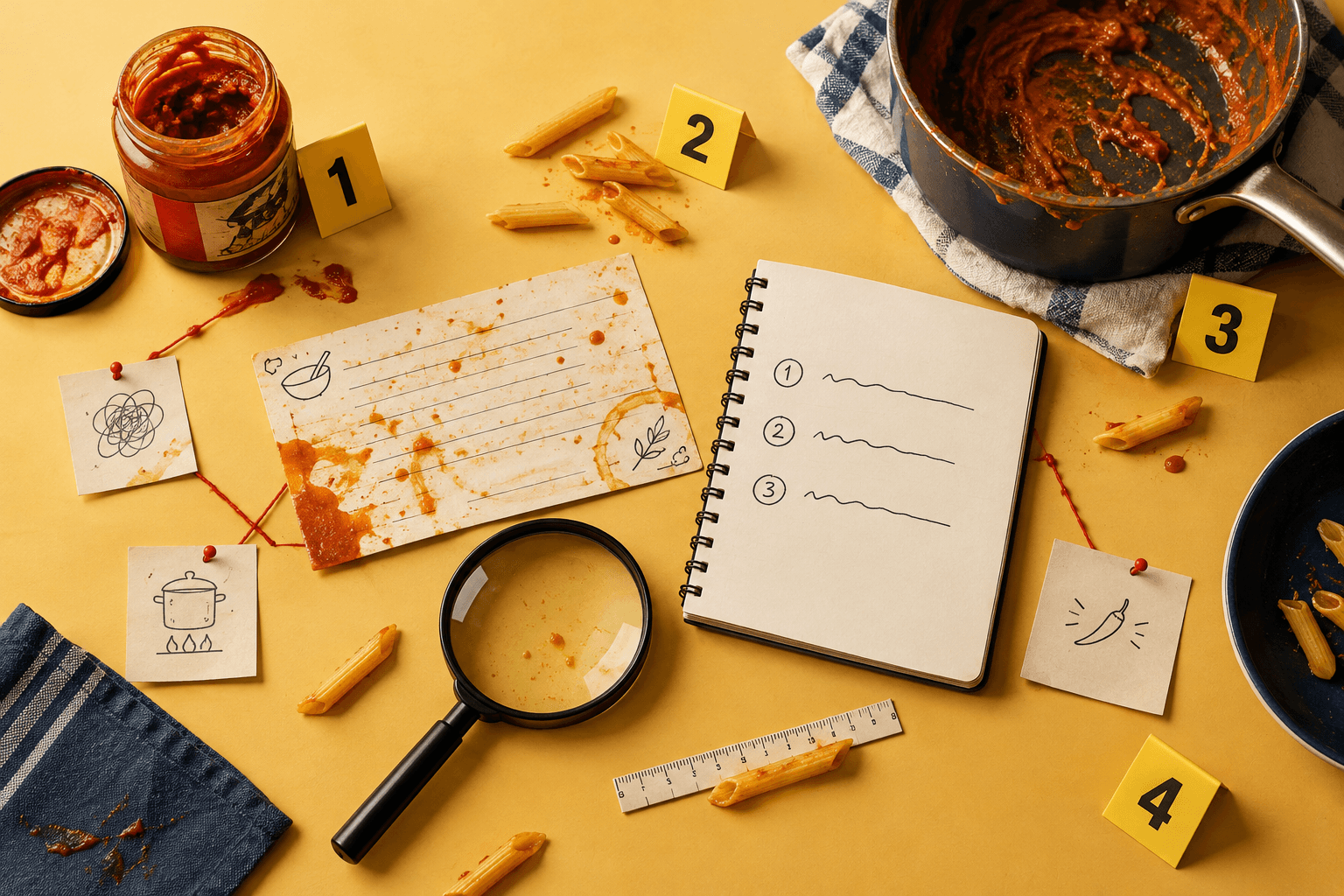
This is the culinary equivalent of leaving a crime scene with a Post-it that says “something happened.”
Useful cooking notes turn a recipe into a living instruction sheet with a tiny field report attached. They preserve the things future-you cannot reliably reconstruct while hungry: the brand of curry paste that was too aggressive, the pan that made the sauce reduce at warp speed, the fact that the recipe claimed to feed six and instead fed two adults plus one person wandering through for “just a bite.”
You do not need to write a novella after every dinner. You need enough evidence to make a better call next time.
Use the “changed, happened, next time” format
A good note usually has three pieces:
- What changed: What did you do differently from the source recipe?
- What happened: What was the actual result?
- What to do next time: What should future-you repeat, adjust, or avoid?
For example:
Used a 10-inch skillet instead of a large sauté pan. Sauce reduced in about 7 minutes and got very thick. Next time use the larger pan only if doubling, otherwise add pasta water sooner.
That is vastly more helpful than “sauce was weird.” Weird is a mood. Future-you needs instructions.
You do not have to use all three parts every time. If you followed the recipe exactly and it worked, a short note is plenty:
Keep this one. Everyone ate it without needing a separate emergency grilled cheese.
Still useful. Still evidence.
Write down the details that vanish first
Some facts remain obvious when you are standing over the stove. By the time dishes are done, they have evaporated from your brain like the exact location of every container lid.
Grab these while cooking, especially when something unexpected happens:
- Ingredient swaps and omissions: “Used Greek yogurt for sour cream.” “Skipped raisins.” “Used regular soy sauce, so held back extra salt.”
- Amounts: “Half the chile was plenty.” “Needed an extra splash of broth.” “Double the sauce if serving this over rice.”
- Timing: “Vegetables needed 8 more minutes.” “Start rice before chopping everything.”
- Equipment: “Used a 9-by-13 pan.” “Cast iron browned the bottom too fast.” “My blender needed a pause and scrape halfway through.”
- Yield: “Made 10 medium tacos, not 16.” “Served four with a salad, two if everybody is very hungry.”
- Texture and seasoning: “Crisp edges, soft center.” “Good after an extra pinch of salt.” “Too sweet with this barbecue sauce.”
- People’s reactions: “Kids rejected the capers.” “Sam asked for more heat.” “Excellent, but only if mushrooms are allowed at the table.”
Household feedback is preference data, not peer-reviewed science. “My partner hated the fennel” is a useful note. “Fennel is bad” is a declaration of war against a vegetable.
Make vague notes earn their keep

“Meh.” “Too dry.” “Fine.” “Add vibes.” These are emotionally honest, and also almost useless on a Tuesday in November when you are trying to decide whether to cook this again.
Give the note a cause, a result, or an instruction.
| Vague note | Better note |
|---|---|
| Too dry | Used chicken breasts and baked them until the vegetables were done. Next time use thighs, or remove the chicken earlier. |
| Needed more flavor | Good texture, but bland with low-sodium broth. Taste before serving and add salt gradually if needed. |
| Took forever | Prep took about 35 minutes because the vegetables were chopped from scratch. Buy pre-cut squash if making this on a weeknight. |
| Too spicy | One full tablespoon of the chile paste made it too hot for this household. Start with half next time. |
| Didn’t work | Batter overflowed a smaller loaf pan. Use the larger pan or divide between two pans. |
Specificity does not mean pretending your kitchen is a laboratory run by extremely tired scientists. You are recording what happened once in your kitchen, with your oven, pan, ingredient brands, and possibly a toddler yelling from another room. That is enough.
A note such as “used a 10-inch skillet and the sauce reduced in 7 minutes” is an observation. “Always use a 10-inch skillet” is a rule you have not earned yet. Let a recipe survive a few repeat appearances before it gets promoted to family law.
Keep the source recipe and your version separate in your head
The original recipe deserves its attribution. If you got it from a cookbook, a website, a friend’s text message, or a stained index card from your aunt, keep the source identifiable.
Your notes are the personal version:
Source calls for 1 pound of spinach. Used 5 ounces because that is what was in the fridge. Still worked, but use the full amount for a greener filling.
Or:
Adapted from [source]: swapped pecorino for Parmesan because that is what I had. Sharper and saltier, so reduce added salt next time.
This protects a useful distinction. The source recipe is where the original instructions came from. Your adaptation is the accumulated record of how you make it work for your household. Both belong in the story. Nobody needs to accidentally claim they invented somebody else’s lasagna because they added more garlic.
For bigger changes, label them plainly: “Weeknight version,” “Doubled for potluck,” or “My less-spicy version.” A future cook should be able to tell whether they are making the original or your increasingly specific director’s cut.
Take one note during cooking, then finish after dinner
Trying to document every stir like a nature filmmaker will make cooking worse. The goal is low friction.
A realistic routine looks like this:
During cooking: Capture one or two moments that will disappear first. Maybe you discover the pan is too small, the onions need longer than the recipe says, or you used half the stated amount of hot sauce. Type a fragment, dictate it, scribble it on paper. Fragments are allowed. This is not your memoir.
After eating: Add one quick verdict while the food is still fresh in everyone’s memory. Note whether the yield was accurate, whether the seasoning landed, and whether you would make it again. Turn the observation into a next-time action when needed.
For instance:
During: Started onions 10 minutes early. They were still pale at the recipe’s stated time.
After: Great flavor. Makes 4 generous bowls. Next time start onions first, then prep the remaining ingredients.
That is a complete cooking note. It took perhaps a minute. It may save you from repeating the exact same onion-based betrayal forever.
A few note templates worth stealing
Use these as fill-in-the-blank prompts, not homework.
Substitution
Replaced ___ with ___. Result: ___. Next time: ___.
Timing
At ___ minutes, it was ___. Needed ___ more/less time. Next time: ___.
Cookware
Used a ___ pan/appliance. It caused ___. Next time use ___.
Yield
Made ___ servings/pieces in practice. Enough for ___.
Seasoning
With ___ brand/amount, it tasted ___. Next time ___.
Texture
Best texture happened when ___. Avoid ___ because ___.
Household feedback
___ liked ___. ___ disliked ___. For this household, ___.
The last phrase matters. “For this household” keeps you from treating one person’s anti-caper campaign as a universal culinary truth.
Keep safety rules out of the vibes folder
Cooking notes can capture personal preferences and practical reminders. They cannot establish whether food is safe to eat.
“Leftovers tasted great the next day” is a quality note. It does not prove anything about safe cooling, storage, or reheating. Likewise, smell, appearance, and a past occasion when everyone survived are not reliable safety tests. Your refrigerator has enough chaos without asking it to run a clinical trial.
If you need guidance about leftovers, storage, cooling, reheating, or safe handling, use current advice from the USDA Food Safety and Inspection Service, rather than a casual note from last February. The USDA’s broader food-safety basics guidance is also a better authority than “it smelled normal.”
A personal note can say, “Check USDA guidance before storing extra soup.” It should not invent its own safety rule.
Put the note where the recipe lives
A note saved in a random phone note, a chat with yourself, or the back of a grocery receipt has a brief and beautiful life. Then it disappears precisely when the skillet is hot and you need it.
Keep your adaptations with the recipe itself whenever possible. That way, when you pull up the recipe again, the source instructions and your practical corrections appear together.
A recipe manager can make this less annoying. Spiceful is a personal recipe manager for home cooks: you can save recipes in your own library, import recipes from URLs or pasted text, and import recipe photos on mobile. You can also edit saved recipes, including imported ones, so you can keep the original instructions identifiable while adding your own corrections and reminders. Review imported recipes before relying on them, since extracted information may need fixing.
As your collection grows, being able to search, filter, organize, and favorite recipes helps you find the recipe again. It does not matter how insightful your note about “use the big Dutch oven” was if it is stranded in a folder called Notes 2024, beside a parking receipt and a list titled “things I should maybe buy.”
Leave future-you a usable instruction, not a tiny culinary riddle. They are already trying to make dinner.
Ready to tame the chaos? Build your recipe book.
- Save recipes from anywhere
- Turn ingredients into one tidy list
Start free. No credit card needed. Upgrade anytime.