How Much Chopped Onion Is in a Medium Onion? A Useful Range
A medium onion usually gives about 3/4 to 1 cup chopped, but “medium” is not a precise culinary unit. Learn when to measure, how to adjust for onion size, and why cut size changes the answer.
The Spiceful Team
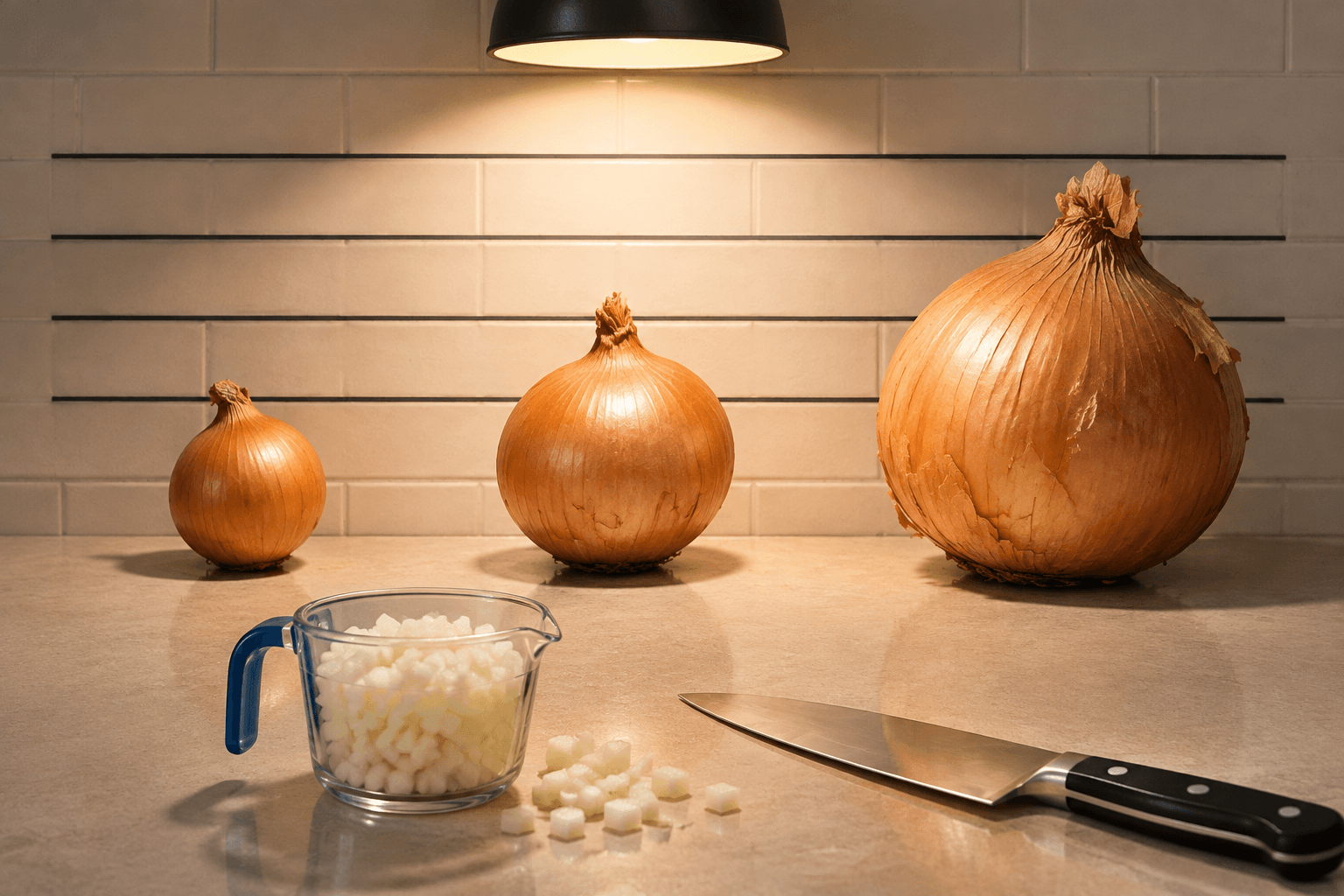
A medium onion is roughly 3/4 to 1 cup chopped for ordinary home cooking.
That is good-enough kitchen math, not a law of onion physics. “Medium” is a grocery-store description, and grocery stores have clearly never convened a summit to define it. One person’s medium yellow onion is another person’s bowling ball with a papery jacket.
For soup, sauce, chili, or a long-cooked flavor base, aim for that range and keep moving. For salsa, onion dip, vinaigrette, or a burger topping where raw onion is front and center, chop first and measure the amount the recipe asks for.
The mildly annoying math behind a medium onion
The USDA FoodData Central entry for raw onions lists these household reference portions:
- 1 medium raw onion, about 2 1/2 inches across: 110 g
- 1 cup chopped onion: 160 g
Those numbers do not neatly produce a universal conversion. If one medium onion were always one cup chopped, those reference portions would match much more closely. They do not.
That does not mean either number is wrong. USDA portions are nutrition-data references, while a cup of chopped onion depends on the onion itself, how much gets trimmed away, and what “chopped” looks like in the recipe writer’s head. Which is, regrettably, a place none of us can visit.
The common cooking convention, including guidance from the National Onion Association, tends toward a medium onion yielding around a cup chopped. Treat that as a useful target, not a promise signed by every onion in produce.
Good-enough kitchen math
For 1 medium onion, use about 3/4 to 1 cup chopped onion.
- Have a small onion? Use most or all of it.
- Have an ordinary medium-looking onion? Use the whole thing.
- Have a very large onion that could plausibly host a tiny farmers market? Start with roughly half to two-thirds.
- Does the recipe give a chopped volume or weight? Chop first, then measure that amount.
The onion type matters too. If a recipe calls for red onion, use red onion when you can. Red, white, yellow, and sweet onions differ in flavor and often in size. Swapping a sweet onion into a raw salad may change more than the arithmetic. A yellow onion in a simmering tomato sauce gives you much more room to improvise.
Cut size makes the cup measure slippery

“Chopped” is already doing a lot of work here.
A fine dice settles and packs differently from a rough chop. The same onion can therefore produce different cup measurements depending on the cut. A loosely filled cup of big chunks and a cup of tiny, densely settled pieces are both technically a cup, which is comforting only if you enjoy being haunted by measuring conventions.
For most cooked recipes, do not chase laboratory precision. Chop the onion roughly as the recipe suggests and use the visual amount that seems sensible for the dish.
If the recipe says 1 cup finely diced onion, though, it means the final prepared amount matters. Dice it, put it in a measuring cup, and reserve any extra for tomorrow’s eggs, sandwich, or the eternal little container of chopped onion in the fridge. No storage timeline is being offered here. The onion’s future is between you and your meal plan.
When you can eyeball it, and when you should actually measure
A cooked aromatic base is usually forgiving
A medium onion is often part of a background crew with garlic, celery, carrots, spices, and whatever else is making the kitchen smell like dinner might work out after all. In a pot of tomato sauce, lentil soup, braise, or curry, a little more or less onion rarely changes the recipe’s basic structure.
Use the onion you have. If it is enormous, do not automatically deploy the whole beast just because the recipe says “one.” Add a reasonable amount, cook it down, and save the rest.
Raw onion is louder
Raw onion has nowhere to hide. Double the onion in pico de gallo, a creamy dip, or a tuna salad, and every bite may become an aggressively personal encounter.
When onion is raw and obvious, follow a stated volume or weight. If the recipe only gives a whole-onion count, start conservatively. You can add more chopped onion. Removing it after it has joined the salsa is a less elegant operation.
Some recipes care about yield
Stuffing, fritters, dumpling fillings, baked savory pies, and recipes built around a specific batch size can be more sensitive to extra produce. Onion contributes moisture and bulk as well as flavor. Measuring is worthwhile when a recipe’s texture, filling quantity, or final yield depends on it.
A cup measure is helpful. A kitchen scale is even more repeatable when the recipe gives grams or ounces. This is one of the rare moments when the scale gets to emerge from the cabinet and feel briefly superior.
Read the wording before you attack the onion
Recipe phrasing usually tells you when to measure.
- “1 medium onion, chopped” generally means start with one medium onion, then chop it.
- “1 cup chopped onion” means chop onion until you have one cup of the prepared ingredient.
- “110 g onion, diced” means weigh the onion amount, then dice it, unless the recipe gives a more specific note.
This is a sensible recipe-reading convention, not an international treaty. Punctuation and house styles vary, and a well-written recipe may add clarifying details. When it gives an explicit prepared volume or weight, follow that instead of trying to reverse-engineer how many onions the author had on their counter.
The same trick works for garlic, lemons, potatoes, and herb bunches
Produce counts are frequently vibes disguised as instructions. A clove of garlic can be dainty or the size of a thumb. A lemon can be stingy with juice. Herb “bunches” appear to be assembled according to local folklore.
Use this small field guide:
- Find the requested final form. Juice, zest, mashed potato, chopped herbs, and minced garlic are clearer targets than whole-item counts.
- Use a stated weight or prepared volume when the recipe provides one. That is the recipe giving you the answer key. Take it.
- Consider the ingredient’s job. A little variation in potatoes for a soup may be fine. Lemon juice in a custard or a big mound of raw garlic in a dressing deserves more care.
- Write down what worked. Your usual grocery store may sell giant lemons, tiny garlic, and onions with ambitions. Future-you will appreciate the note.
Avoid collecting universal conversions for every piece of produce. They tend to become fake precision very quickly. “Three cloves equals exactly…” is the sort of statement that lasts right up until a recipe hands you three cloves the size of decorative pebbles.
Give your future self the version that actually worked
If you regularly cook from saved recipes, edit the wording to match your real-world ingredients. For example: “Use 1/2 of our giant yellow onions” is far more useful than pretending every onion is medium forever.
Spiceful lets you save and edit your own recipes, so you can add that kind of personal note directly to the recipe you actually use. No conversion engine required. Just fewer arguments with produce.
For tonight, chop about 3/4 to 1 cup for a medium onion, measure if onion is doing a starring raw role, and let the sauce survive a little ambiguity. It has seen worse.
Ready to tame the chaos? Build your recipe book.
- Save recipes from anywhere
- Turn ingredients into one tidy list
Start free. No credit card needed. Upgrade anytime.