How to Scale a Recipe Down Without Letting One Egg Ruin Your Evening
Use the scale-factor formula to shrink recipes for one or two people, then handle the real problems: partial eggs, half cans, pan size, cook times, and whether leftovers are the better plan.

The Spiceful Team
A recipe serves four. There are two of you. The arithmetic is easy:
Scale factor = desired servings ÷ original servings
Multiply each ingredient quantity by that number.
For two people from a four-serving recipe, the scale factor is 2 ÷ 4 = 0.5. Halve the ingredients. For one person, it is 1 ÷ 4 = 0.25. Quarter them.
That takes about five seconds. Then the recipe asks for one egg, half a can of coconut milk, and a baking dish whose dimensions were apparently passed down by an ancient guild. Welcome to the part where dinner develops a minor math degree.
Start with the portions you actually want
Recipe serving counts are estimates, not legally binding portion contracts. “Serves four” might mean four modest side portions, two hungry-adult dinners, or four portions with a tiny amount of sauce left over that causes immediate household tension.
Picture the meal before doing the math. Is it chili with bread? Pasta with salad? Brownies that you are claiming are for guests even though you have already emotionally claimed them?
If a recipe labeled “serves four” is realistically dinner for two in your house, making the stated quantity may already be the right choice.
A serves-four recipe, scaled for two or one
Imagine a soup recipe that makes four portions:
| Ingredient | Original, serves 4 | For 2, multiply by 0.5 | For 1, multiply by 0.25 |
|---|---|---|---|
| Chicken broth | 4 cups | 2 cups | 1 cup |
| Diced tomatoes | 1 can | 1/2 can | 1/4 can |
| Onion | 1 medium | 1/2 onion | 1/4 onion |
| Garlic | 2 cloves | 1 clove | 1/2 clove |
| Ground cumin | 1 teaspoon | 1/2 teaspoon | 1/4 teaspoon |
| Cooked beans | 2 cups | 1 cup | 1/2 cup |
The broth, beans, and cumin are simple. The quarter onion is annoying but manageable. The quarter can of tomatoes introduces a small container into your refrigerator, where it may begin a mysterious second life.
For one person, ask whether quartering is actually making dinner easier. A half batch might give you dinner and lunch, use more sensible quantities, and save you from measuring half a garlic clove like a tiny culinary accountant.
When making the full recipe is smarter
A full batch can be the better option when reducing it creates more hassle than it saves. That is especially true when:
- the recipe uses awkward amounts, such as one egg or one can
- a baked dish depends on a particular pan
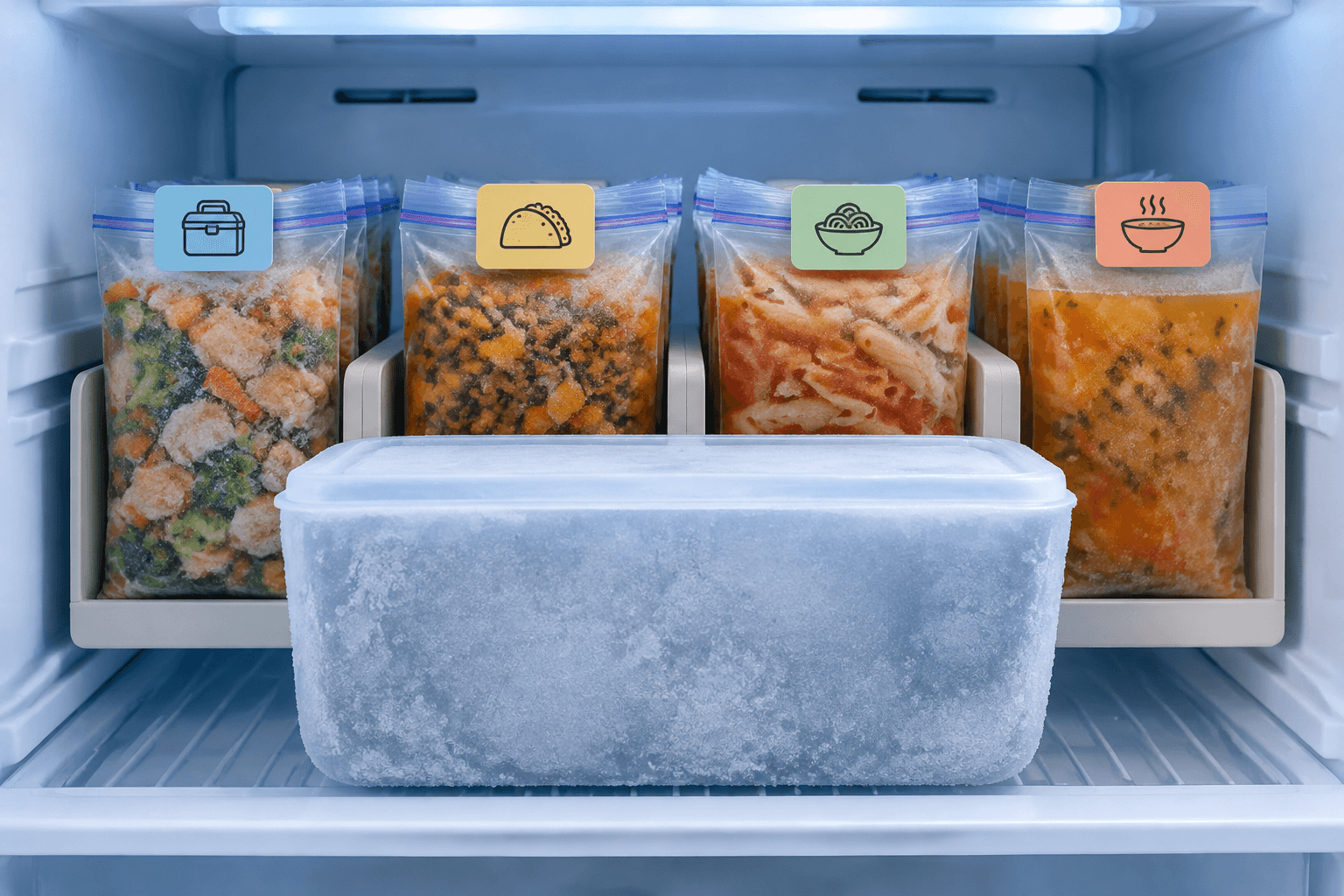
- the food freezes or reheats well for your purposes
- you genuinely want leftovers
- the recipe is naturally batch-friendly, such as soup, stew, chili, a braise, or some sauces
The last point matters. “Planned leftovers” are useful. “A container of food you keep moving around the refrigerator until it becomes an ethical question” is a different project.
A delicate skillet dinner may be easier to reduce, while a pot of chili can make tomorrow’s lunch without much additional drama. Choose based on what you will actually eat, not on an imaginary future version of yourself who is thrilled to find four more portions of the same meal.
If you choose leftovers, handle them safely
Safety and quality are separate questions. Day-three pasta may be safe when handled correctly and still have the texture of a tired office printer.
The USDA Food Safety and Inspection Service says to refrigerate perishable food within 2 hours, or within 1 hour when the temperature is above 90°F. USDA says cooked leftovers can be refrigerated for 3 to 4 days and advises reheating them to 165°F.
Do not use smell or appearance as proof that food was handled safely. For a specific opened can or leftover ingredient, storage guidance varies. Check an authoritative reference such as FoodKeeper instead of applying one universal deadline to every half-can in the fridge.
The ingredients scale. The cooking physics does not

The formula changes quantities. It does not resize your skillet, predict evaporation, or persuade your oven to behave consistently after 6 p.m.
A half batch of sauce in the same wide pan may reduce faster because it is shallower and has more surface area relative to its volume. A smaller roast may finish sooner, but the answer depends on its thickness and cooking method. Half a batch of batter in a large pan can turn into a thin, overexposed sheet with the structural confidence of wet cardboard.
Treat a reduced batch as a new version of the recipe. Watch it earlier than the original timing suggests and use the recipe’s relevant doneness cues. Do not divide the cooking time by the same number you used for the flour, broth, or beans.
A half batch does not automatically mean half the time. The pan has opinions.
Handling the awkward quantities
Eggs
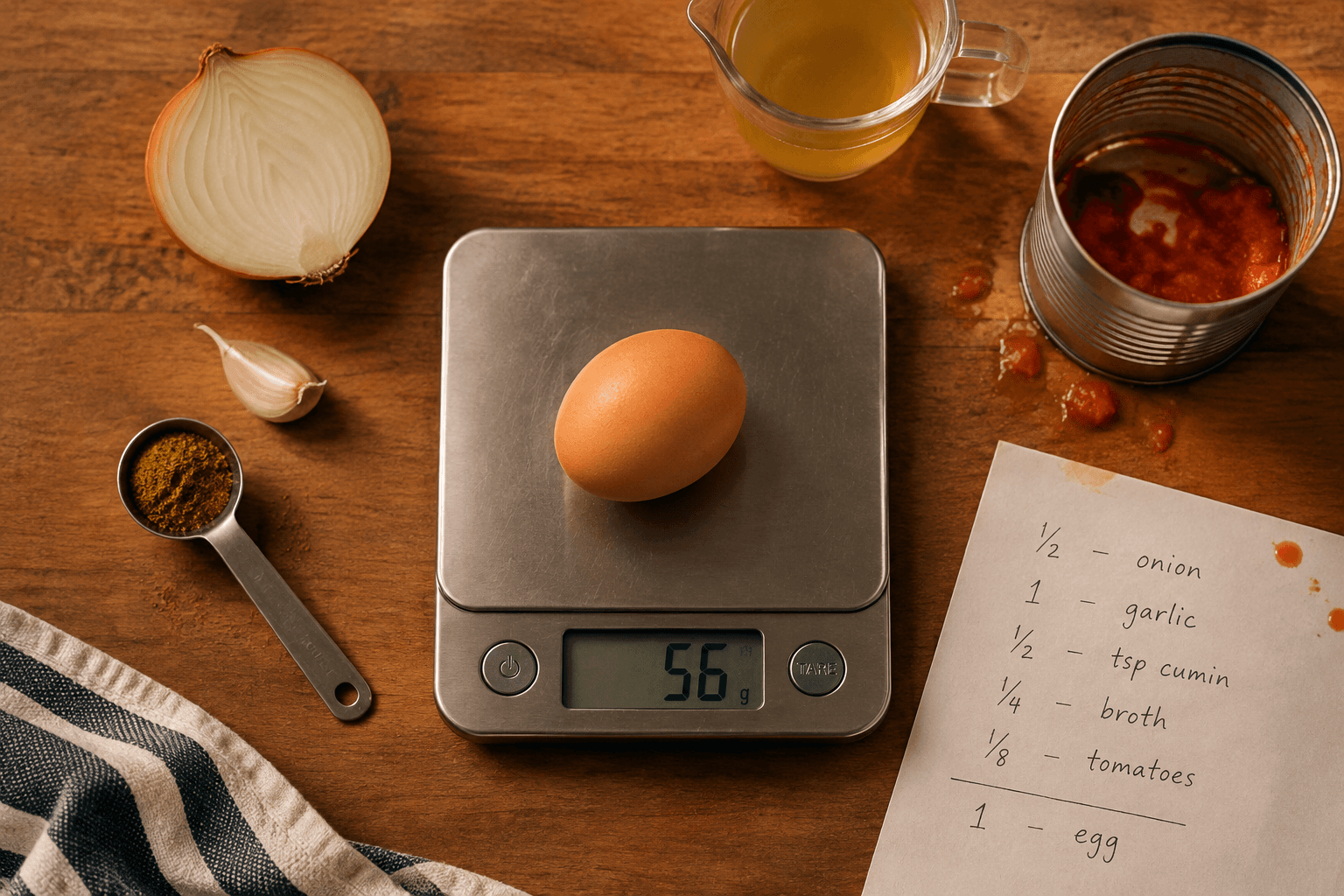
For half or a quarter of one egg, crack it into a bowl and beat it until uniform. Then weigh the amount you need.
King Arthur Baking’s ingredient weight chart lists a large egg without its shell at about 50 g. That makes half an egg roughly 25 g and a quarter roughly 12.5 g. Egg sizes vary, so use those figures as a practical reference rather than a law of nature.
In a savory dish, a little rounding may be fine. Cakes and custards are less forgiving. For egg-heavy baking, a tested small-batch formula is usually a better starting point than performing surgery on three eggs.
Partial cans
Half a can of beans, tomatoes, coconut milk, or broth is common enough to deserve a plan.
Use a smaller can or carton if one is available and you will use it. Otherwise, portion the excess for a meal you have actually planned. Some ingredients freeze well in recipe-sized portions, but texture and suitability vary, so do not assume every opened can wants a freezer bag.
Another perfectly respectable option is choosing a recipe that uses the whole can. The internet contains many recipes. You do not have to defeat every ingredient with algebra.
Tiny amounts of stock, dairy, and seasoning
Measuring spoons and a liquid measuring cup work for small amounts of stock or dairy. A digital scale becomes useful when the fractions get especially small, particularly in baking.
For salt, chile, acids, garlic, and concentrated pastes, treat the calculated amount as a starting point when the recipe allows. Add more after tasting. Removing excess cayenne from soup requires dilution or a completely different relationship with consequences.
Baking needs a pan plan
For cakes and similar batters, look for a pan that keeps the batter at roughly the same depth as the original. Similar depth is a better starting point than simply grabbing any smaller pan from the cabinet.
Pan geometry changes baking. A shallower layer may finish sooner, while a deeper layer may need longer and bake differently in the center. King Arthur Baking’s cake-pan conversion guidance explains why pan capacity and batter depth matter. Its advice applies most directly to cakes and similar batters, not every brownie, quick bread, custard, or yeast dough.
Keep the original recipe’s useful doneness cues in view. If it describes a tester’s texture or a visual sign, use that information. Start checking a reduced batch earlier than the stated time, then continue as needed.
Do not blindly halve the baking time. Baking is chemistry conducted inside a hot metal shape. It has never respected a spreadsheet.
A low-drama scaling workflow
- Decide how many portions you realistically want.
- Divide that number by the recipe’s stated yield.
- Multiply the ingredient amounts by the result.
- Pause at eggs, cans, pan-dependent baking, and very small seasonings.
- Choose between an adapted batch and deliberate leftovers.
- Check reduced food early, using the original recipe’s applicable doneness cues.
If the adapted version works, save the details. “Half batch, smaller pan, check early” is more useful than trusting your future self to remember what happened three weeks ago. Future-you is trying their best, but future-you also bought cilantro without a plan.
Spiceful can keep that edited version in your personal recipe collection, along with notes about portions or the pan that worked. You can create and edit recipes across the web, iPhone, iPad, and Android. Spiceful does not automatically scale recipes or calculate a revised cooking time, so the final decisions remain yours. The cookware was always going to make this personal.
Ready to tame the chaos? Build your recipe book.
- Save recipes from anywhere
- Turn ingredients into one tidy list
Start free. No credit card needed. Upgrade anytime.